

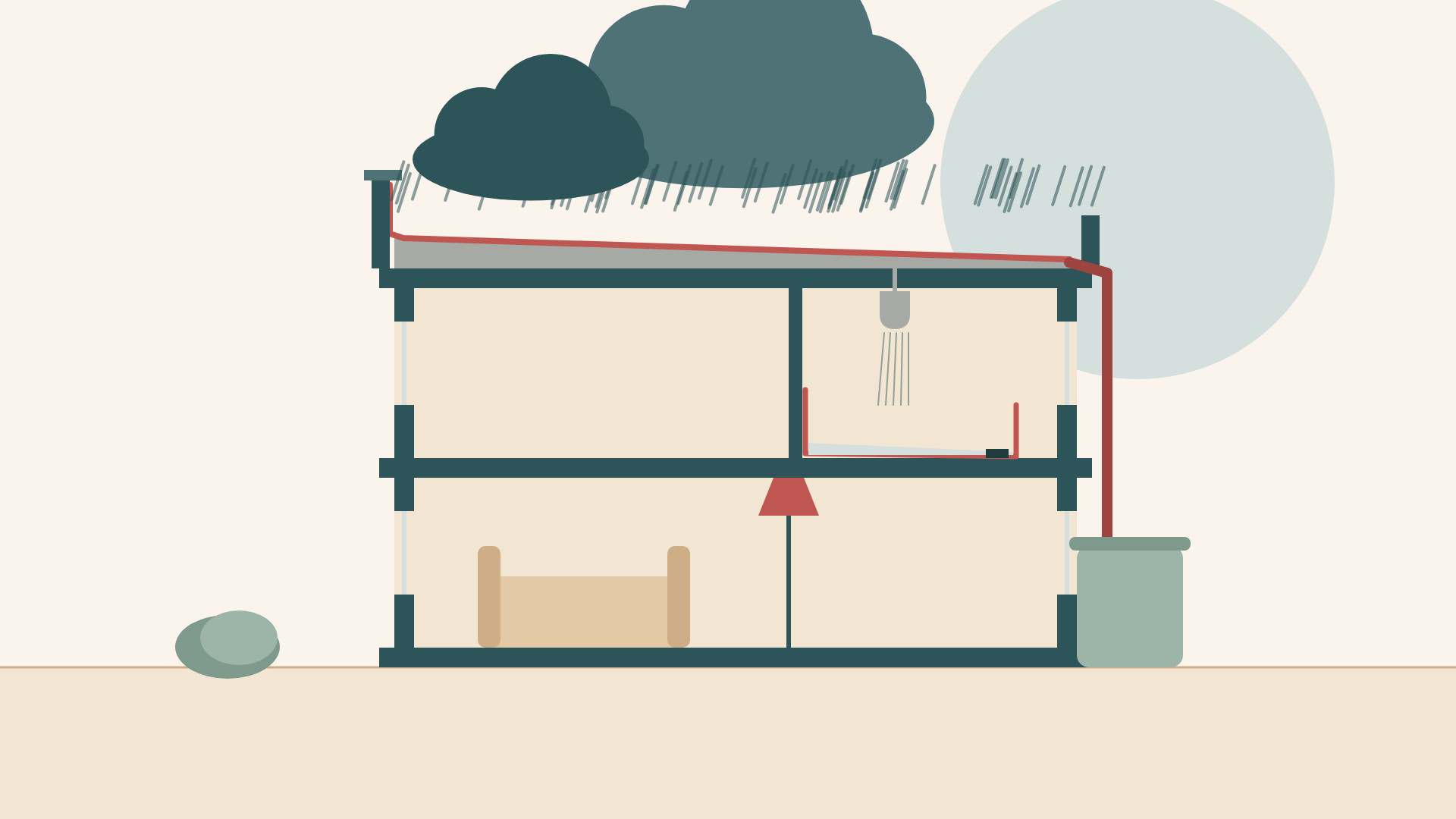
Most roof and bathroom leaks come from three causes: water that cannot drain away, joints and corners that were never detailed, and a waterproofing layer that was never tested. Deal with all three before June. Give the roof a real fall to its outlets, choose a system that suits Odisha's heat and rain, treat every junction, and flood-test the work before any tile or screed covers it.
It matters because a leak does more damage than the stain suggests. Water in a slab corrodes the steel inside it, swells plaster, grows mould and ruins finished interiors. Repair means breaking out tiles and screed to reach a failed layer, which costs far more than doing it right the first time, and usually has to wait for dry weather.
Odisha's monsoon in numbers
According to the India Meteorological Department's rainfall normals for Odisha, the state's normal rainfall from June to September is about 1,150 mm, out of an annual total of about 1,445 mm. July and August are the wettest months, at about 341 mm and 364 mm. October still brings about 112 mm. Khurda district, which includes Bhubaneswar, has a monsoon normal of about 1,087 mm.
The monsoon usually reaches Odisha around 10 June, but it can come early: in 2025 it set in on 28 May, about 13 days ahead of normal. Plan roof and bathroom waterproofing for the dry months from November to April, when surfaces are dry and liquid coatings cure properly.
Did you know? Odisha receives about 80 percent of its normal annual rainfall in just four months, June to September. A roof that copes with a light shower in March can fail in its first week of July.
Get the water off the roof first
No membrane survives standing water for long. The first defence is geometry.
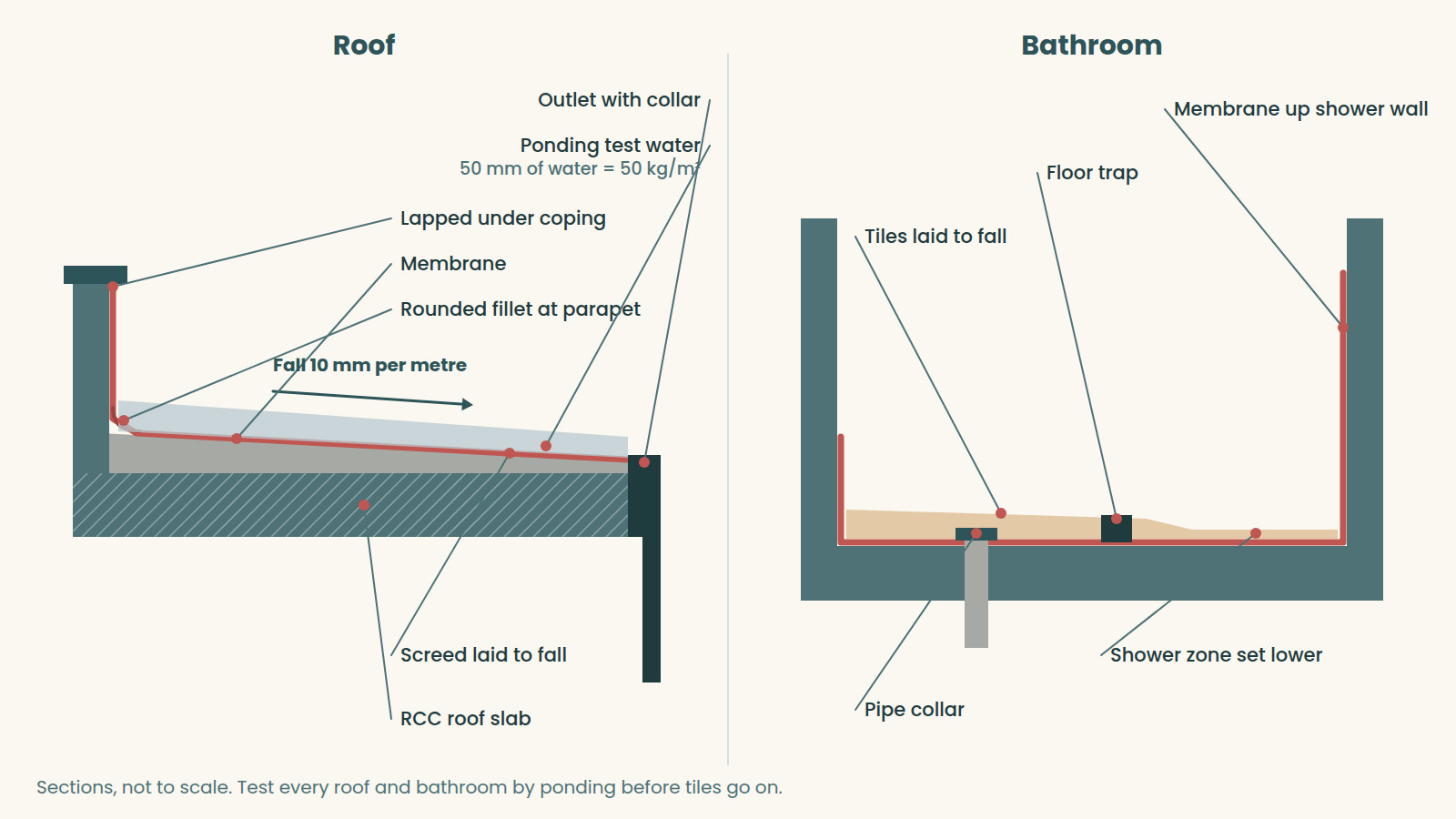
- Give the roof a definite fall toward its outlets, ideally cast into the slab or a lightweight screed, and show it on the drawing. Even a gentle fall such as 1 in 100 means 10 mm for every metre, so the high end of a 10 m roof sits 100 mm above the outlet.
- Provide at least two outlets on every roof area, so one blocked by leaves or a plastic bag does not turn the roof into a pond.
- Set each outlet slightly below the finished surface, with a proper collar that the membrane laps into, and a grating that can be lifted for cleaning.
- Round the junction between roof and parapet with a fillet or cove, and carry the waterproofing up the parapet and under its coping.
Did you know? One millimetre of rain on one square metre is one litre of water. On a 1,000 sq ft roof in Khurda district, an average monsoon delivers about one lakh litres. Every drop has to reach an outlet, which is also why the same roof is worth connecting to rainwater harvesting.
Choosing a roof system for heat, sun and rain
Each common system has a place. The right one depends on exposure, movement and who will apply it.
- APP membranes are bitumen sheets modified with atactic polypropylene, laid with a torch. They tolerate heat and sun well, which suits exposed Odisha roofs. Their weak points are the overlaps, so they need skilled applicators and inspected seams.
- SBS membranes use a rubbery polymer, styrene-butadiene-styrene, which makes them more flexible and better at following movement. They usually need protection from sunlight, either a mineral-surfaced top sheet or a screed or tiles over them.
- Liquid polyurethane coatings form a joint-free, elastic skin that wraps easily around pipes, corners and outlets. They need a dry, sound surface, so apply them in the dry season, and an ultraviolet-resistant top coat where they stay exposed. Ask how the applicator will control thickness.
- Polymer-modified cementitious coatings bond well to concrete, are economical, and work best under tiles, in bathrooms and in water tanks. They bridge only small cracks, so they are a weak choice for an exposed roof that moves with heat every day.
- Brick-bat coba, the traditional layer of broken brick in lime or cement mortar, gives slope and some insulation but adds a lot of weight. Once it cracks, it holds water like a sponge and makes leaks hard to trace. If you use it, put a proper membrane under or over it, not instead of one.
Odisha's climate adds two rules. Roofs here cycle between strong sun and heavy rain, so every system needs either protection or a top coat that resists ultraviolet light. And a reflective or white finish on the roof cuts heat entering the top floor, which our guide to keeping a house cool without AC covers.
Bathrooms: sunken slabs, slopes and joints
Bathrooms leak in quieter ways than roofs, usually into the ceiling of the room below or the wall behind a shower.
The traditional sunken slab, a recessed slab filled with brick rubble to hide pipes, is a common culprit. When its waterproofing fails, the filling becomes a reservoir that leaks for months. Where you can, avoid deep sunken slabs: route pipes in the wall or a shallow drop, waterproof the slab itself, and fill with lightweight material only above an intact, tested membrane.
The details that matter most:
- Waterproof the whole floor and carry it up the walls, to full height around the shower.
- Fillet or tape every floor-wall corner, and seal every pipe that passes through with a purpose-made collar or puddle flange.
- Lay the floor to fall toward the trap, and check the fall with water before tiling.
- Keep the shower area slightly lower than the rest of the floor, so water does not run to the door.
- Use epoxy or similar water-resistant grout in the shower zone, and keep a lifting cover over the trap for cleaning.
Plan bathrooms one above another where possible, so pipes stay short and any leak shows in a bathroom, not a bedroom. Walls matter too: an AAC wall in a wet zone needs protection on its face, as our comparison of AAC blocks, red bricks and fly ash bricks explains.
Test before you tile
A ponding test, also called a flood test, proves the work before it disappears. Plug the outlets, build a small dam at the edges, and fill the roof or bathroom floor with water to a depth of a few centimetres. Mark the level, leave it for at least a full day and night, ideally two, and check the ceiling below and the level mark. A 50 mm depth of water weighs only 50 kg per sq m, well within what a normal slab carries.
If the level drops or a damp patch appears, find and fix the defect, then test again. Only then should protective screed, tiles or a top coat go on. Ask for the test to be dated, photographed and written into the handover file.
What to ask your contractor
- Which system, which manufacturer, and the product's data sheet.
- How many coats or layers, at what thickness, over what primer.
- How outlets, parapets, pipes, corners and joints will be detailed, with a drawing.
- When the ponding test will be done, and who will witness it.
- What the warranty covers, for how long, and who honours it.
Write these into the bill of quantities so that bids are comparable. Near the sea, salt air and wind-driven rain raise the stakes; our note on building near the coast in Odisha covers that. After handover, clear the outlets before June and inspect the roof after the first heavy storm.
Questions people ask
When is the best time to waterproof a roof in Odisha?
In the dry months, broadly November to April, when surfaces are dry and coatings can cure. Aim to finish and test before the monsoon's usual arrival around mid-June, allowing for an early onset.
Which waterproofing is best for a terrace?
It depends on exposure and movement. APP membranes and ultraviolet-resistant liquid polyurethane suit exposed roofs; SBS membranes suit roofs that will be covered; cementitious coatings suit bathrooms and tanks more than open roofs.
Can a bathroom leak be fixed without breaking tiles?
Grout sealing and surface coatings can slow a minor leak, but they rarely cure a failed membrane below the tiles. A lasting repair usually means reaching the layer that failed.
How long does waterproofing last?
It depends on the system, the exposure and whether it is protected from sun. Ask for the manufacturer's stated life and the applicator's warranty in writing, and plan an inspection every year.
Where an architect makes the difference
Most leaks are designed in long before they appear. An architect decides the roof falls and outlet positions, stacks the bathrooms, avoids needless sunken slabs, specifies the right system for each surface, and draws the junctions that contractors otherwise improvise. During construction, our construction management in Odisha team checks the falls, the layers and the ponding tests before anything is covered.
If you are building or repairing before the next monsoon, talk to our architects.