

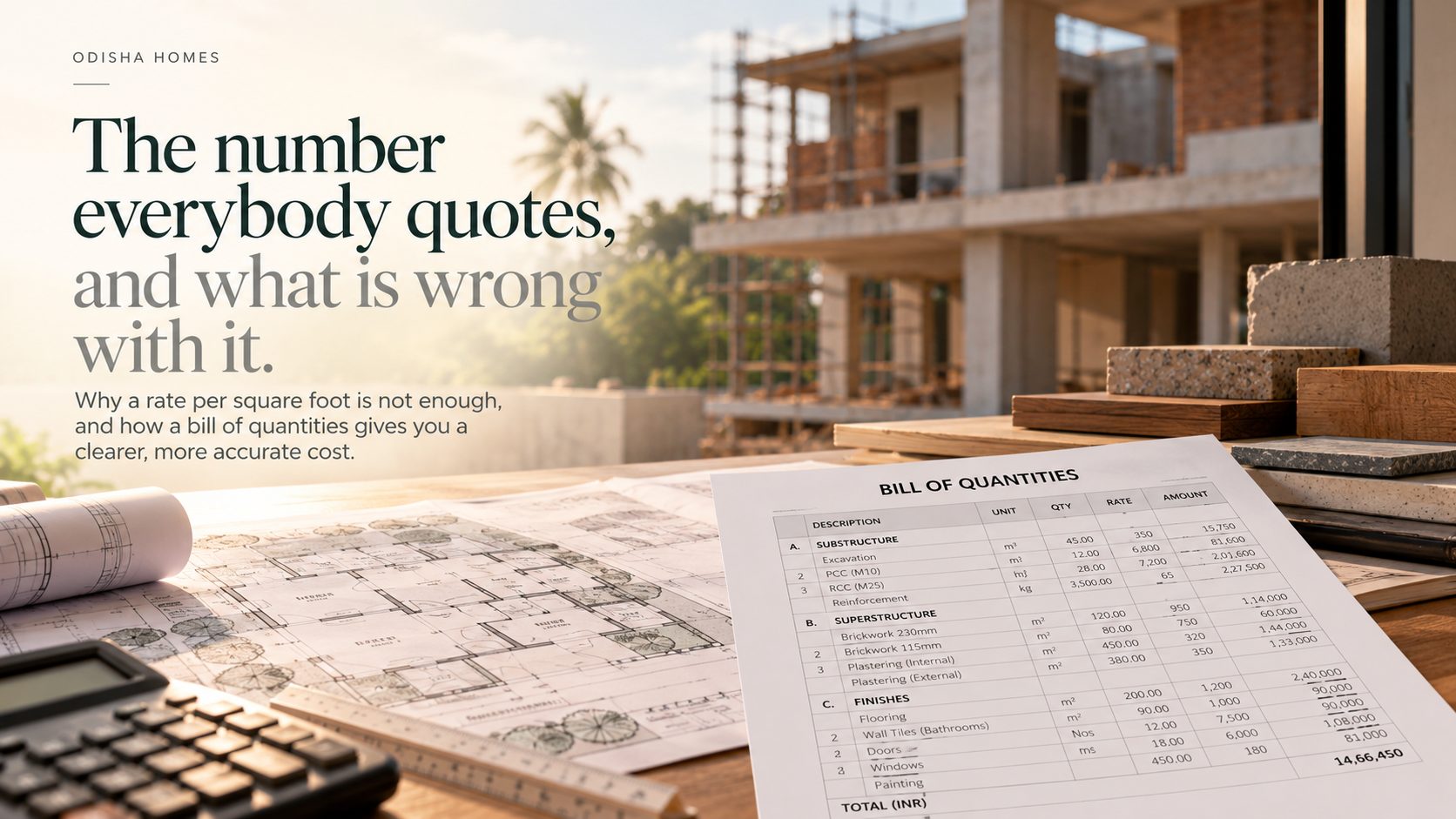
The Number Everybody Quotes, and What Is Wrong With It
Ask what it will cost to build a house, and you will usually get a rate per square foot multiplied by the proposed area.
It is a convenient starting point, but it tells you very little about what your project will actually cost. It conceals the decisions that drive the budget: the number of floors, soil conditions, structural requirements, specifications, number of bathrooms, choice of materials, level of customisation and quality of finishes.
Two houses with the same built-up area can have significantly different construction costs because their requirements are different. A single rate cannot adequately capture those differences.
The problem is not using a square-foot rate for an initial estimate. The problem is treating that rate as a reliable final budget without measuring what the project actually requires.
What Is a Bill of Quantities?
A Bill of Quantities (BOQ) is a structured, measured schedule of the work and materials required to execute a project, prepared from the relevant drawings and specifications.
It breaks the project into identifiable items, with a unit of measurement, quantity, rate and amount. Depending on the scope, these may include:
- Earthwork and excavation, measured in cubic metres.
- Concrete, classified by grade and measured by volume.
- Reinforcement steel, measured by weight.
- Brickwork and blockwork, measured by volume or area as appropriate.
- Plastering, waterproofing and flooring, measured by area or other relevant units.
- Doors, windows and sanitary fittings, specified and quantified by type.
- Electrical installations, plumbing and other building services, measured according to the applicable items of work.
The quantities are derived from the drawings, while the rates are established using the specified materials, labour, construction methods and prevailing project-specific pricing.
A BOQ therefore connects the design to its cost. Instead of asking only how much the house costs per square foot, you can examine what is included, how much is required and how each item contributes to the total.
Where a BOQ Changes the Conversation
A measured BOQ makes construction costs easier to understand, compare and control in four important ways.
1. It makes the price traceable.
You can see the quantities, rates and amounts behind the total instead of relying on a single consolidated figure. This makes it easier to identify omissions, assumptions and unusually high rates.
2. It makes contractor comparisons meaningful.
Two contractors may quote different totals because they have assumed different specifications, quantities or scopes of work. Comparing their quotations against a common BOQ and specification helps reveal those differences before the contract is signed.
3. It helps identify where savings are possible.
When a client asks whether the budget can be reduced, a BOQ provides a practical starting point. It may reveal opportunities in flooring, finishes, joinery, fittings or other specified items. Structural changes, however, must be evaluated by the design and engineering team rather than treated as simple cost-cutting decisions.
Often, a few carefully selected changes can achieve more than reducing the quality of every item across the project.
4. It provides a basis for pricing variations.
If a wall moves, a finish changes or an additional item is introduced, the financial impact can be assessed against the revised quantities, agreed rates and applicable contractual terms. This reduces ambiguity and makes changes easier to document.
A BOQ does not eliminate cost overruns by itself. Its value depends on the accuracy of the measurements, completeness of the scope, quality of the rates and discipline with which changes are managed.
Why the Timing of BOQ Preparation Matters
A BOQ prepared too early may rely on assumptions that change as the design develops. A BOQ prepared after construction has begun may arrive too late to influence important decisions.
For a reliable construction budget, the BOQ should be developed from coordinated working drawings, relevant technical details and clearly defined specifications.
This means the architectural design, structural requirements and building services need to be coordinated to the extent necessary for the intended estimate and contract scope.
Where information is not yet finalised, the uncertainty should be identified explicitly. Provisional quantities, allowances and exclusions should not be presented as though they were fully measured and confirmed.
The objective is not simply to produce a detailed spreadsheet. It is to produce a cost document that reflects the design and scope the contractor is actually expected to execute.
What Should You Ask for Before Signing a Construction Contract?
Before committing to a contractor, ask for the following:
- A BOQ based on the working drawings: Not just an indicative rate multiplied by the built-up area.
- Clear material specifications: Include relevant grades, brands or approved equivalents, finishes and quality standards.
- A defined scope of work: Establish what is included, what is excluded and which items are being supplied separately by the owner.
- Transparent rates and quantities: Make the basis of the quoted amount understandable and comparable.
- Clearly identified provisional items: Understand which quantities, specifications or costs remain uncertain and why.
- Written variation procedures: Agree how changes will be instructed, measured, valued and approved.
- A payment schedule linked to defined work: Ensure that payment milestones and certification requirements are clear in the contract.
A contractor who is unwilling to explain the basis of a quotation makes it harder for you to understand what you are committing to. The priority should be transparency, a clearly defined scope and a fair basis for comparison.
How NAVOARCH Approaches Construction Cost Planning
At NAVOARCH, we see cost planning as an integral part of architectural design and project delivery, not a calculation to be completed after the design is frozen.
Our approach connects the drawings, specifications, quantities and budget so that decisions can be evaluated before they become expensive site-level changes.
We work towards four outcomes:
- Clarity: Understand what the project includes and where the money is allocated.
- Comparability: Evaluate contractor quotations against a consistent scope and specification.
- Control: Assess the cost implications of design decisions and proposed changes.
- Coordination: Align the cost document with the drawings and the intended construction scope.
The result is a more informed basis for budgeting, procurement and execution. Actual costs will still depend on market rates, site conditions, final specifications and changes during construction, but those variables can be managed more transparently when the project begins with a properly prepared BOQ.
A Better Way to Build
A square-foot rate can help you begin a conversation about budget. It should not be the only number you rely on when committing to construction.
Understand the quantities. Define the specifications. Compare quotations on the same basis. Record changes before they become disputes.
A better construction budget begins with a better understanding of what you are building.