

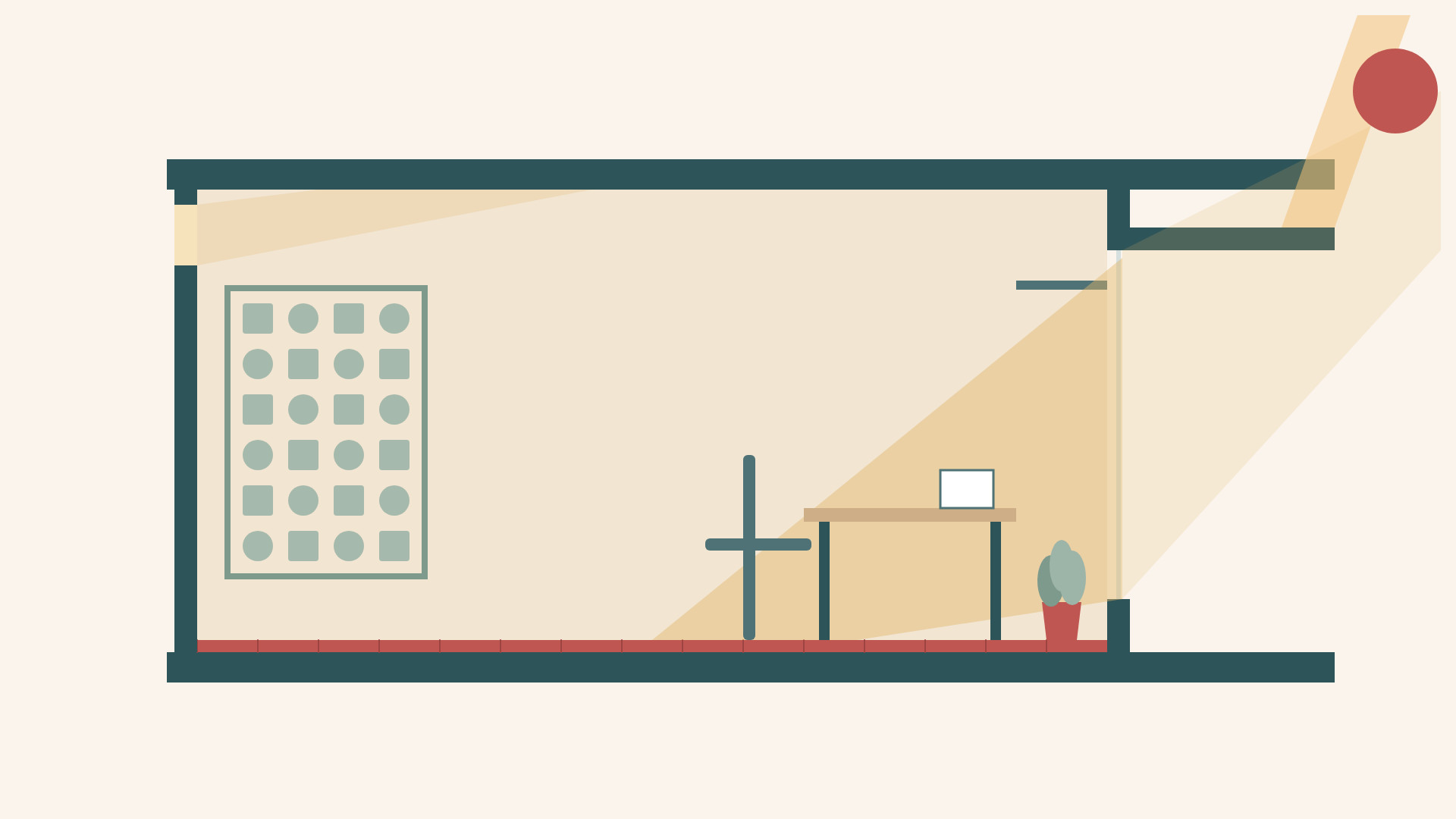
Good natural light comes from the right amount of window, in the right wall, shaded the right way. In a hot-humid city like Bhubaneswar, give each room openable windows of about one-sixth of its floor area, put most of the glass on the north and south, shade south windows with a horizontal sunshade and east and west windows with fins or a verandah, and bring light in from two sides or from above.
Windows are where daylight comes in, but they are also where most unwanted heat and glare arrive. Get the balance wrong and you live with drawn curtains at noon and the lights switched on. Get it right and rooms feel larger, cooler and calmer, at no running cost at all. This guide sets out the numbers an architect works with and the reasons behind them.
How much window does a room need?
Many Indian building bye-laws ask that the windows and ventilators of a habitable room add up to at least one-tenth of its floor area. Treat that as a floor, not a target, and check the exact rule your authority applies. The Bureau of Energy Efficiency's residential energy code, Eco-Niwas Samhita, classifies Bhubaneswar as warm-humid and asks for an openable window area of at least 16.66 percent of the floor area in that climate, roughly one-sixth. It also advises keeping a home's window-to-wall ratio at or below 0.40, because beyond that the heat coming in outruns the benefit of the light.
Take a bedroom of 3.6 m by 3.3 m, about 11.9 square metres. One-tenth is 1.2 square metres of opening; one-sixth is about 2.0 square metres that can actually open. Note the word openable. A two-track sliding window only ever opens half its width, so it needs roughly twice the glass of a side-hung casement to give the same open area.
Rooms also need different amounts of light. The Indian daylighting standard, IS 2440, recommends a daylight factor (the share of outdoor overcast-sky light that reaches the work surface) of 2.5 percent for a kitchen, 1.9 percent for a study and 0.625 percent for a living room. A kitchen needs four times the daylight factor of a living room, which is why a good window over the cooking counter matters more than a large one beside the sofa.
How deep daylight reaches into a room
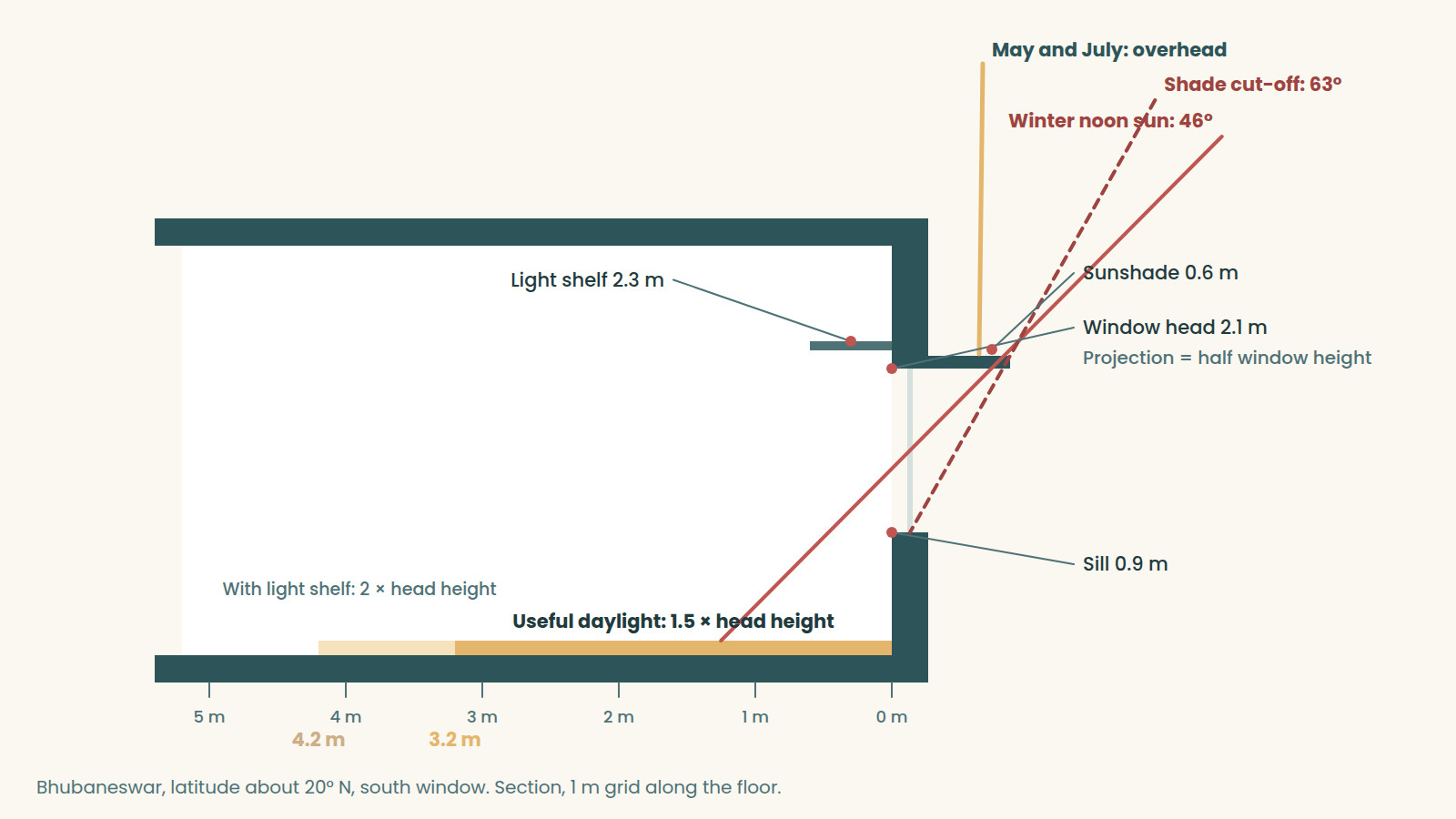
Did you know? A conventional window lights a room usefully only to a depth of about one and a half times the height of its head above the floor. With a window head at 2.1 m, that is about 3.2 m. Light shelves and similar devices can push it to about twice the head height, around 4.2 m. Beyond that, the back of the room needs lamps by day, however wide the window.
This one rule explains a great deal. Taking the window head up close to the ceiling, instead of stopping it at a standard 2.1 m lintel, throws light deeper. A room more than about 4.5 m deep from its only window will always feel dim at the back, so deep rooms need a second window on another wall, a clerestory, or light borrowed from a courtyard or stairwell. Light from two sides also evens out brightness, which is the single best cure for glare.
Surfaces matter as much as openings. Light-coloured ceilings and upper walls bounce daylight further in; dark wooden ceilings and dark floors swallow it.
Which walls should carry the glass
Orientation decides how easy a window is to live with. Our guide to which way your house should face covers the plot as a whole; here is what it means for each wall of glass.
- North: steady, soft light with little direct sun for most of the year. The best wall for large windows, studios and work desks.
- South: strong sun, but high in the sky for most of the year, so a simple horizontal sunshade controls it.
- East: pleasant morning light, but the sun is low and reaches deep into the room, bringing glare.
- West: the hardest wall. Low afternoon sun arrives when the air is already at its hottest. Keep the glass small, or shade it completely.
Between the March and September equinoxes the sun rises north of east and sets north of west, so even north windows catch some low sun early and late in the day. Short vertical fins at their sides deal with it.
Shading that keeps heat out and lets light in
A south window is the easy one. In Bhubaneswar the noon sun in late December still stands about 46 degrees above the southern horizon, and it climbs higher for the rest of the year.
Did you know? At Bhubaneswar's latitude, a sunshade that projects only half as far as the window is tall keeps the noon sun off a south window from about early March to early October, and then lets it in through the cooler months. The arithmetic is simple: such a shade works whenever the noon sun is more than about 63 degrees high.
East and west windows need a different tool. Because the sun is low, a horizontal chhajja casts a short shadow and the sun slips in under it. Vertical fins angled away from the sun, a perforated jaali, adjustable louvres, a deep verandah or a well-placed tree do far more. Eco-Niwas Samhita itself gives credit for fixed overhangs and side fins when it calculates the heat a window lets in.
Prefer shading outside the glass to tinted glass. Dark tints cut heat, but they also cut the light you put the window there for. The code sets a minimum visible light transmittance of 0.27 for glazing when the window-to-wall ratio is up to 0.30, precisely to stop rooms going gloomy. Our guide to keeping a house cool without AC explains how shading, roof and ventilation work together.
Glare: bright is not the same as well lit
Glare is mostly contrast. A bright window in a dark wall, a patch of sun on a desk, low evening sun in the eyes, or a window reflected in the television screen all make a room tiring to use even when there is plenty of light.
- Light every important room from two sides where the plan allows it.
- Splay or whiten the window reveals, so the eye steps down gently from bright sky to wall.
- Place desks side-on to the window, never facing it and never with the window behind the screen.
- Keep the television wall away from large east or west windows.
- Use sheer curtains, jaalis or louvres to soften low morning and evening sun.
A light shelf, a horizontal shelf at about 2.3 to 2.4 m above the floor inside or outside the window, shades the lower glass and reflects sunlight up onto the ceiling. It works best with clear skies and direct sun, and it is no substitute for proper shading on east and west walls.
Clerestories, skylights and courtyards
Light from above is the most effective daylight there is. A clerestory, a band of high windows above a lower roof, brings daylight into the middle of a deep plan and, if it opens, lets hot air escape at the top of the house. A small internal courtyard does the same for a whole cluster of rooms.
Skylights need care in Odisha. A flat, unshaded skylight faces the near-overhead summer sun and becomes a heater. Better options are small skylights with a shading grid, raised roof monitors with vertical glass facing north, or a skylight over a stair or passage, where a little extra heat matters less than in a bedroom.
Common mistakes we see
- Windows sized to make the elevation symmetrical rather than to suit the room behind them.
- Full-height glass on the west, followed by heavy curtains that stay shut.
- Sliding windows counted as if they open fully.
- Dark tinted or reflective glass used instead of shading.
- Long, deep rooms lit only from one narrow end.
- Sunshades fixed well above the window head, so the sun gets in beneath them.
Questions people ask
How big should a bedroom window be?
As a starting point in Bhubaneswar, an openable area of about one-sixth of the floor area, split between two walls if possible. A 12 square metre bedroom needs about 2 square metres of window that can open.
Is a north window better than a south window?
North light is softer and more even, which suits work and reading. South light is stronger but easy to shade with a horizontal sunshade. A well-planned house uses both and keeps west glass to a minimum.
Do skylights make a house hot?
Large, flat, unshaded skylights do. Small, shaded or north-facing roof lights bring in plenty of daylight with far less heat.
Is tinted glass a good idea?
Only as a supplement. External shading stops heat before it reaches the glass, and keeps both the view and the daylight. Very dark tints leave you switching lights on by day.
Where an architect makes the difference
On your plot, the answers depend on things no rule of thumb knows: which walls the setbacks leave free, how close the neighbours stand, where the trees and the street are, and how each room will be used at each hour. A good architect runs a sun-path study for the actual site, sizes each window for the room behind it, sets sunshade depths by orientation and checks that daylight reaches the back of every deep space. That is ordinary work in our architecture practice, and it carries through into how our interior design team chooses finishes, colours and window treatments.
If you would like your own plan looked at this way, talk to our architects.