


Three Forces Shaping Coastal Buildings
Buildings along the Odisha coast face three distinct challenges: salt-laden air, monsoon rainfall, and persistent humidity. Each affects building materials differently, and each requires a specific architectural and construction response.
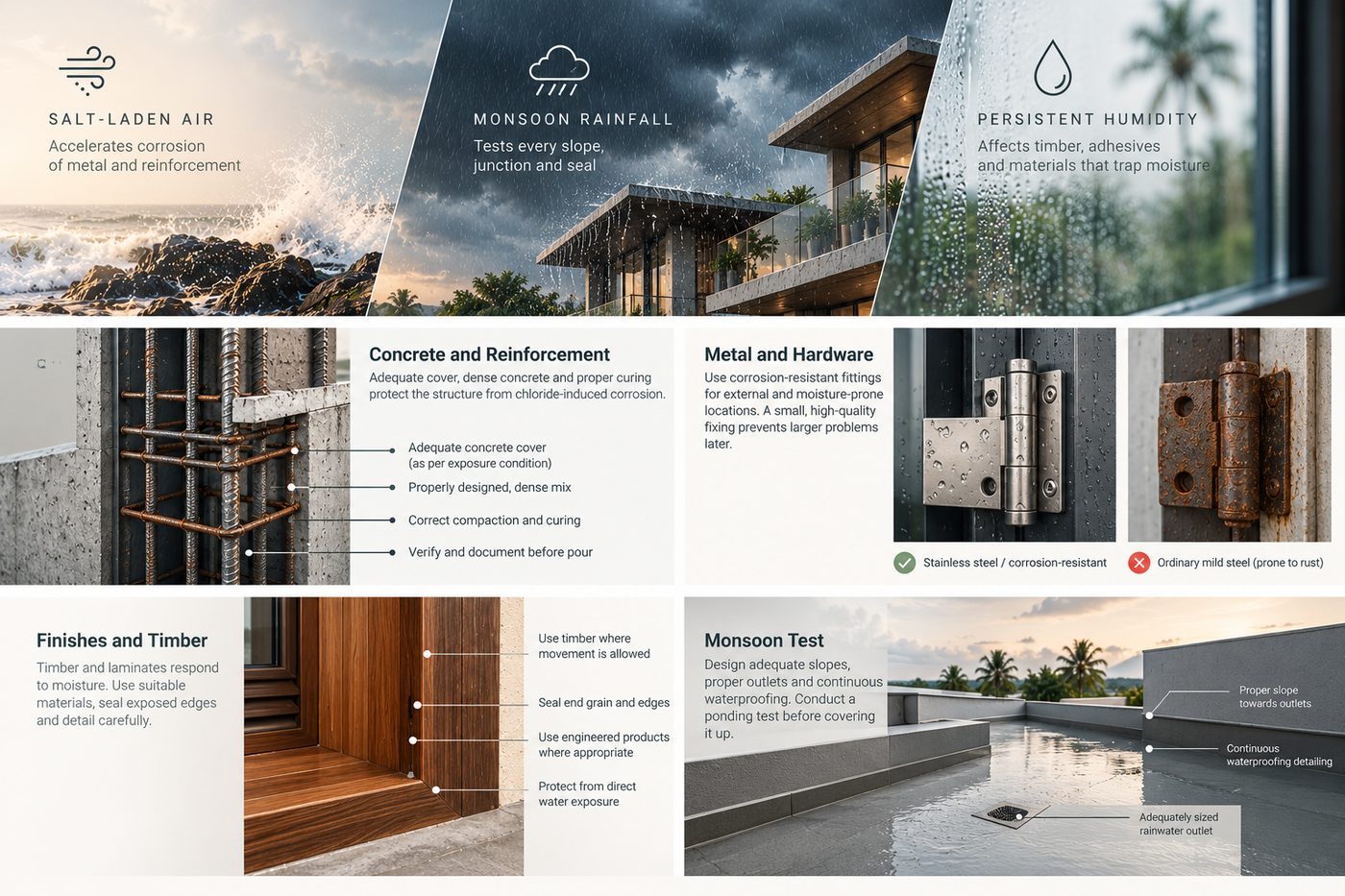
Humidity affects timber, adhesives, laminates, and materials that trap moisture. Monsoon rainfall tests roof slopes, drainage outlets, junctions, and waterproofing seals. Salt in the air accelerates corrosion of metal components and reinforcement when concrete does not provide adequate protection.
These forces often act together. A poorly sealed joint allows moisture to enter, humidity slows drying, and salt accelerates the deterioration of vulnerable metal components. Addressing only one of these conditions leaves the building exposed to the others.
Concrete and Reinforcement: Protecting the Structure
In coastal construction, concrete cover and concrete quality play a critical role in structural durability. Chlorides can penetrate porous concrete and initiate reinforcement corrosion. As the steel corrodes, it expands, causing cracks, concrete delamination, and progressive deterioration.
The solution begins long before the concrete hardens.
- Verify reinforcement cover: Check the specified concrete cover and reinforcement positioning before every pour.
- Ensure dense concrete: Use an appropriately designed mix with proper placement and compaction.
- Cure correctly: Follow the specified curing procedure and duration.
- Specify for exposure: Select concrete requirements appropriate to the applicable environmental exposure conditions.
- Document quality checks: Record reinforcement inspections and concrete quality checks before the work is concealed.
These measures become difficult to verify once the structure is complete. Inspection before concreting is therefore an essential part of quality control, not an optional site procedure.
Metal and Hardware: Small Components, Big Consequences
Coastal humidity and salt exposure can accelerate corrosion in ordinary steel fixings, hinges, window tracks, fasteners, and exposed metalwork. When these components deteriorate, the damage often extends to the doors, windows, shutters, and other elements they support.
A corroded hinge on a custom-designed shutter, for example, can eventually become a joinery replacement problem rather than a simple hardware repair.
Specify corrosion-resistant hardware for external and moisture-prone locations. Protect exposed steel with a suitable coating system, and ensure that adjoining materials and finishes are compatible with the exposure conditions.
The additional cost of a suitable fixing is often negligible compared with the cost of repairing or replacing the component it supports.
Finishes, Timber and the Monsoon Test
Timber responds to changes in moisture content. Swelling, shrinkage, warping, and joint failure can follow when material selection and detailing do not account for these movements.
Use timber where movement can be accommodated, select suitable engineered products where appropriate, and seal exposed end grain and vulnerable edges. Adhesives and laminates also require careful detailing because moisture frequently enters through poorly sealed edges, joints, and penetrations.
The monsoon places particular demands on terraces, balconies, roofs, and external walls. Good detailing must manage water before it reaches the building envelope.
- Design effective drainage: Provide adequate falls towards rainwater outlets, avoiding unintended ponding.
- Size outlets appropriately: Design rainwater drainage for the applicable rainfall conditions.
- Detail waterproofing continuously: Pay particular attention to corners, upstands, thresholds, and pipe penetrations.
- Test before covering: Conduct a ponding test where appropriate before concealing the waterproofing system.
- Inspect and rectify: Resolve leakage and drainage issues before installing finishes over the waterproofing.
A waterproofing test is inexpensive compared with the cost of repairing damage to ceilings, finishes, electrical installations, and occupied spaces after a leak develops.
The Short Version
Coastal durability is not achieved by choosing a single premium material. It comes from coordinating the right specifications, detailing, installation, and quality checks throughout the project.
Check reinforcement cover before the pour. Specify corrosion-resistant fixings. Seal vulnerable edges and junctions. Ensure effective rainwater drainage. Test waterproofing before it is concealed.
None of these measures is exotic. Their effectiveness depends on applying them consistently and documenting the work from the drawings through construction.
Designing for Odisha's Climate
At NAVOARCH, coastal durability is considered from the first design decisions rather than treated as a maintenance problem after handover. Material selection, architectural detailing, structural coordination, and construction quality all contribute to a building's long-term performance.
Our architecture and construction management teams integrate these considerations into the design and delivery process, helping clients make informed decisions about buildings in Odisha's demanding coastal climate.
Planning a home or building near the coast? Talk to our architects.