

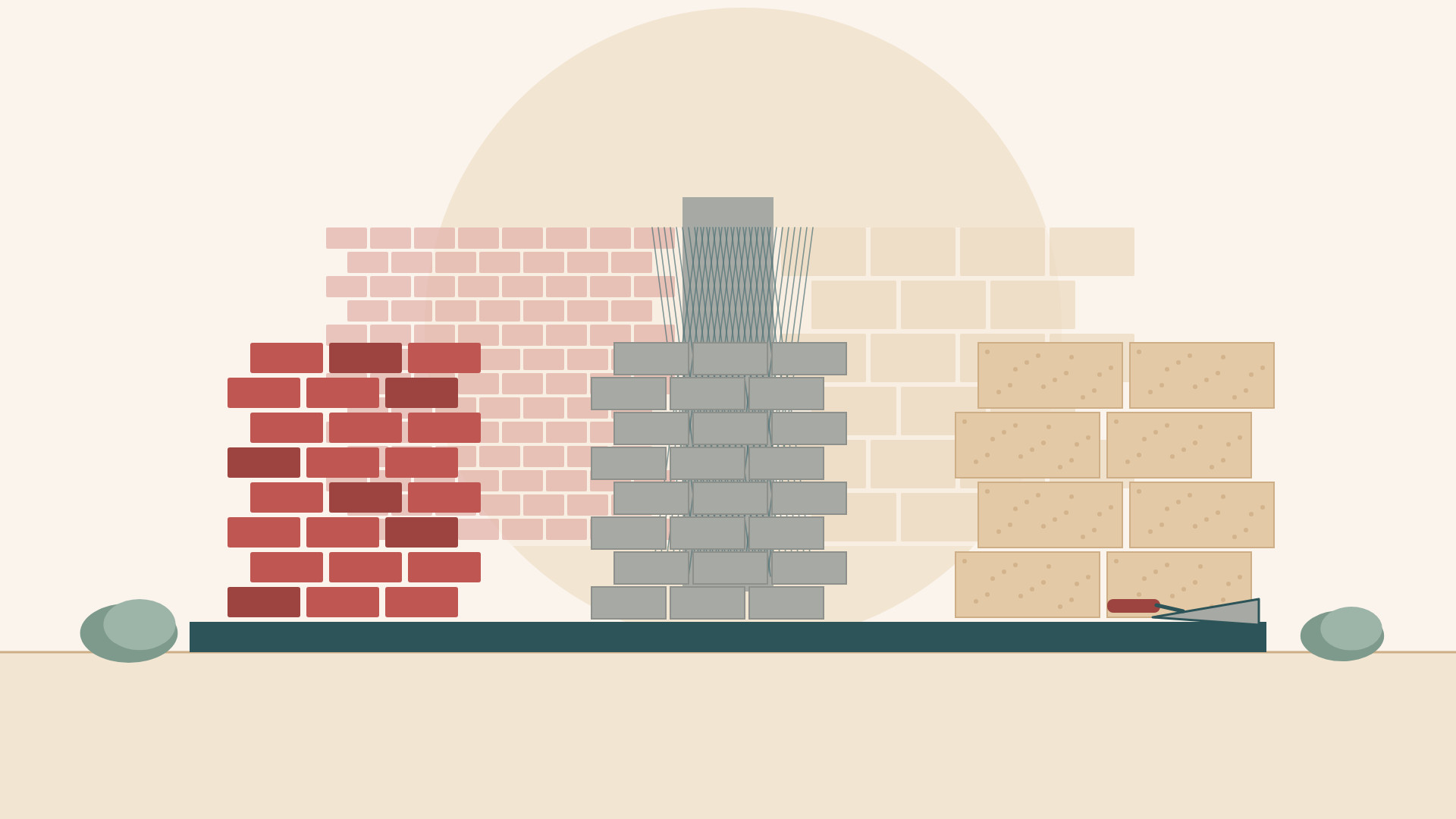
For a framed concrete house in Odisha, AAC blocks usually make the lightest and coolest walls. Fly ash bricks give a regular, well-sized solid wall made from a power-station by-product. Good red clay bricks remain the most familiar and forgiving. None is best everywhere: the right choice depends on each wall's job, its orientation, the moisture it will face and the skill of the masons.
It matters because walls are a large share of a house's weight and of the heat that enters it. The material also decides how much mortar and plaster you buy, how the walls crack, and how a kitchen cabinet or a geyser is fixed to them. Choosing by the price of a single brick or block is the most common mistake.
The three materials in brief
- Red clay bricks are fired clay, made to IS 1077. The standard covers strength classes from 3.5 to 35 N/mm², a modular size of 190 × 90 × 90 mm and the traditional 230 × 110 × 70 mm size. Water absorption is capped at 20 percent by weight for classes up to 12.5.
- Fly ash bricks are pressed from power-station fly ash with lime or cement, sand and gypsum, then cured with water rather than fired. IS 12894 sets classes from 3.5 to 30 N/mm², the same 20 percent absorption cap, and a drying shrinkage of not more than 0.15 percent.
- AAC blocks, short for autoclaved aerated concrete, are a cement, lime and sand or fly ash mix that rises with tiny gas bubbles and is then cured in high-pressure steam. IS 2185 (Part 3) grades them by dry density from about 451 to 1,000 kg/m³. In the common 551 to 650 class, the minimum strength is 4.0 N/mm² for grade 1 blocks and 3.0 for grade 2. Blocks are commonly 600 or 625 mm long and 200 mm high, in thicknesses from 100 to 300 mm.
Weight: what the frame has to carry
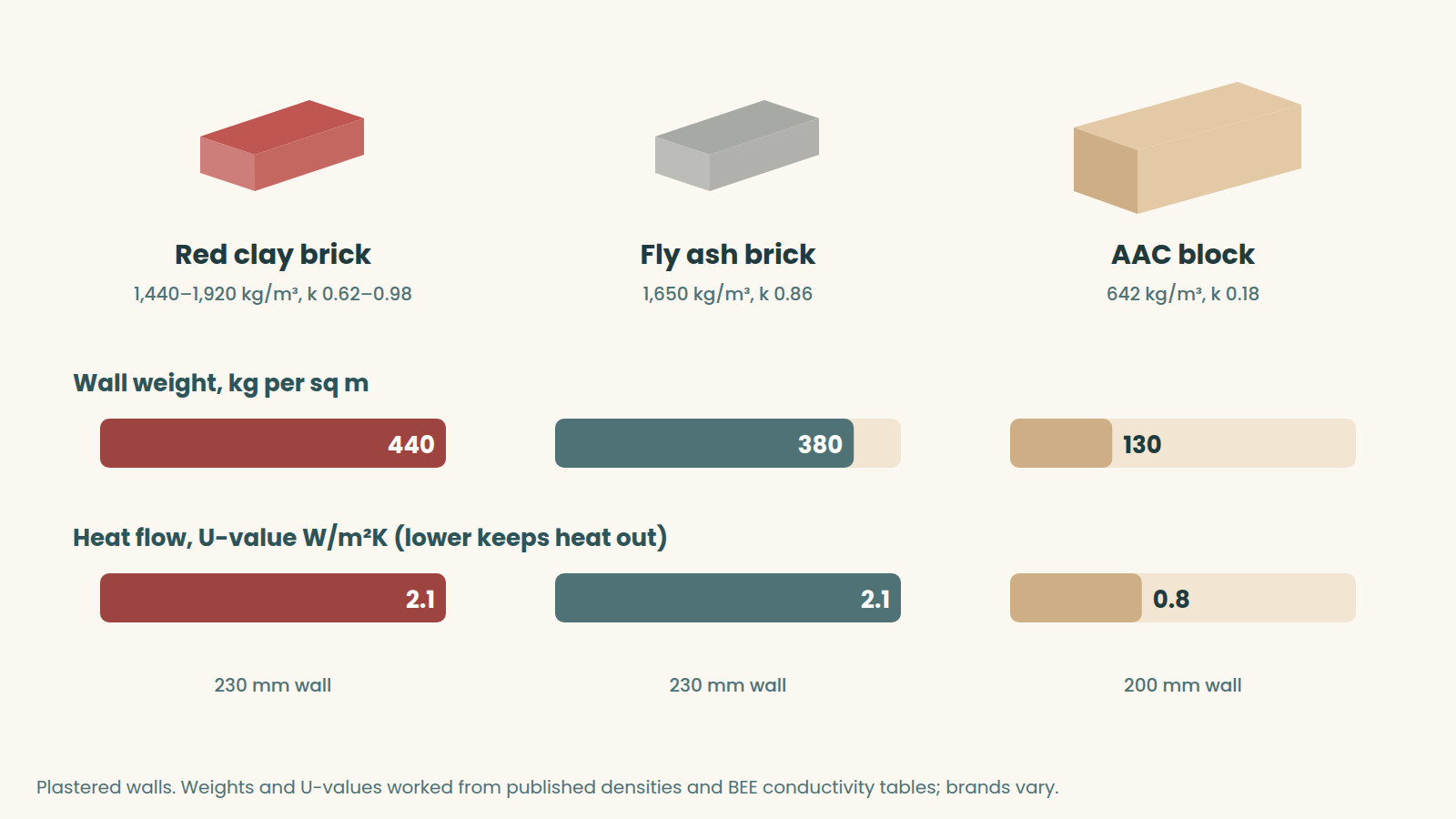
The Bureau of Energy Efficiency's residential code, the Eco-Niwas Samhita, lists solid burnt clay brick at 1,440 to 1,920 kg/m³, fly ash brick at 1,650 and AAC at 642. On those figures, a square metre of 230 mm clay brick wall weighs about 330 to 440 kg before plaster. The same area of 230 mm fly ash brick weighs about 380 kg. A 200 mm AAC wall weighs about 130 kg, roughly a third.
That saving is real only if the structure is designed for it. When the structural engineer knows from the start that the infill walls are AAC, beams, columns and footings can be sized for the lighter load, and a lighter building also attracts smaller earthquake forces. Swapping bricks for blocks after the drawings are done saves weight, not money.
Heat: the question that matters in Odisha
The same code gives thermal conductivity: 0.62 to 0.98 W/mK for clay brick depending on density, 0.856 for fly ash brick, and 0.184 for AAC. So 200 mm of AAC resists heat flow about four times better than 230 mm of brick. Once plaster and the air films on each face are counted, our calculation puts the finished AAC wall at a U-value of about 0.8 W/m²K against about 2.1 for brick or fly ash brick. The AAC wall lets through roughly 60 percent less heat.
Fly ash bricks behave much like clay bricks here. Both are dense and conductive, and both store heat through the day and give it back in the evening. In a warm-humid climate where nights stay warm, that stored heat is rarely welcome in a bedroom.
AAC earns its keep most on west and south-west walls and around bedrooms. Its insulating value drops when the block is wet, so outside faces need sound plaster and paint. Walls are only part of the story; our guide to keeping a house cool without AC covers roofs, shading and air movement.
Mortar, plaster and cracks
Did you know? About a quarter of a brick wall is not brick. With 10 mm joints, a cubic metre of 230 × 110 × 70 mm brickwork holds about 434 bricks, and mortar fills roughly 23 percent of the volume. In 600 × 200 mm AAC blocks with 10 mm joints, mortar is about 6 percent; with a 3 mm thin-bed adhesive, about 2 percent.
AAC needs its own rules. An AAC masonry manual from Bangladesh's government Housing and Building Research Institute sets them out clearly:
- Use a thin-bed adhesive of 3 to 5 mm, or ordinary joints of 8 to 10 mm in a lean 1:4 cement-sand mortar. Richer mixes shrink and crack.
- Keep internal plaster to about 10 mm and external plaster to two coats totalling 12 to 15 mm. Thicker plaster on AAC tends to crack.
- Lay galvanised or expanded mesh in the bed joints, typically every third course, and add thin concrete bond beams in tall walls.
Most AAC cracks come from blocks laid wet or fresh from the factory, cement-rich mortar, thick plaster, and the junction between block and concrete frame, which move differently. Ask for grade 1 blocks: their drying shrinkage limit is 0.05 percent, about 3 mm over a 6 m wall, against 0.10 percent for grade 2. Fix mesh across every block-to-column and block-to-beam junction before plastering, and let the wall dry before plaster and paint.
AAC is also soft. Geysers, kitchen wall units and television brackets need anchors made for aerated concrete, or a concrete band or solid block placed where the load will hang. Decide those positions before the walls go up.
Moisture, humidity and the coast
Clay and fly ash bricks may absorb up to 20 percent of their weight in water. AAC absorbs far more by weight, about 33 to 47 percent in the figures quoted in the draft revision of its standard, partly because the block itself is so light. That does not make AAC walls leak, but it does mean they must be protected: keep AAC off the ground on a solid plinth course, plaster both faces, and finish the outside with a good exterior paint.
Clay bricks bring a different risk: efflorescence, the white salt bloom that appears as walls dry. IS 1077 allows no more than moderate efflorescence for classes up to 12.5. Near the sea, salt air adds to the load on every material, and our note on building near the coast in Odisha covers the details. In any humid season, store bricks and blocks raised off the ground and covered.
The fly ash rule, and how to compare cost
Did you know? The fly ash rule is not only for government buildings. Under the environment ministry's notification S.O. 5481(E) of 31 December 2021, as amended in January 2024, building projects within 300 km of a coal or lignite power plant, including private ones, are to use ash-based products such as ash bricks or tiles, where these are available at no more than the public works schedule-of-rates price.
Odisha's Works Department has required fly ash bricks in government buildings within 100 km of such plants since 2013. For a private house, the practical test is supply: a fly ash brick that meets IS 12894, with test reports for strength and absorption, sharp edges and true sizes.
For cost, compare the price of a square metre of finished, plastered wall, not a single unit. Include the units, mortar or adhesive, plaster, labour, wastage, transport and any saving in the structure. Put those rates in a bill of quantities so that bids can be compared line by line. Our guide to house construction cost per sq ft shows where walls sit in the overall budget.
Questions people ask
Can AAC blocks carry load in a house?
IS 6041 covers load-bearing AAC masonry, but most houses in Odisha use a concrete frame with AAC as infill. If walls are to carry load, a structural engineer must design for the block's grade and strength. Never assume it.
Do AAC walls crack more than brick walls?
Not when built correctly. Dry blocks, lean mortar or thin-bed adhesive, mesh at every junction with the frame and thin plaster prevent most cracks. Problems usually trace back to workmanship, not the block.
Are fly ash bricks good in Odisha's humid climate?
Yes, if they meet IS 12894 and have been fully cured. Ask for test reports, check that edges are sharp and sizes regular, and reject bricks that crumble at the corners or come straight off the press.
Which is cheapest?
Per piece, the answer changes with distance from the factory. Per square metre of finished wall, add up units, mortar, plaster and labour, then subtract any saving in the frame.
Choosing for your own walls
A good architect rarely picks one material for the whole house. The decision is made wall by wall: AAC where heat and weight matter most, such as west walls and upper floors; well-burnt clay or fly ash brick where walls meet the ground or stay wet; and a clear detail for every junction with the frame. Then the grades, tests and laying method go into the specification, and someone checks them on site. That is what our construction management in Odisha is for, alongside our architecture practice.
If you would like help choosing walls for your own house, speak with our architects.