

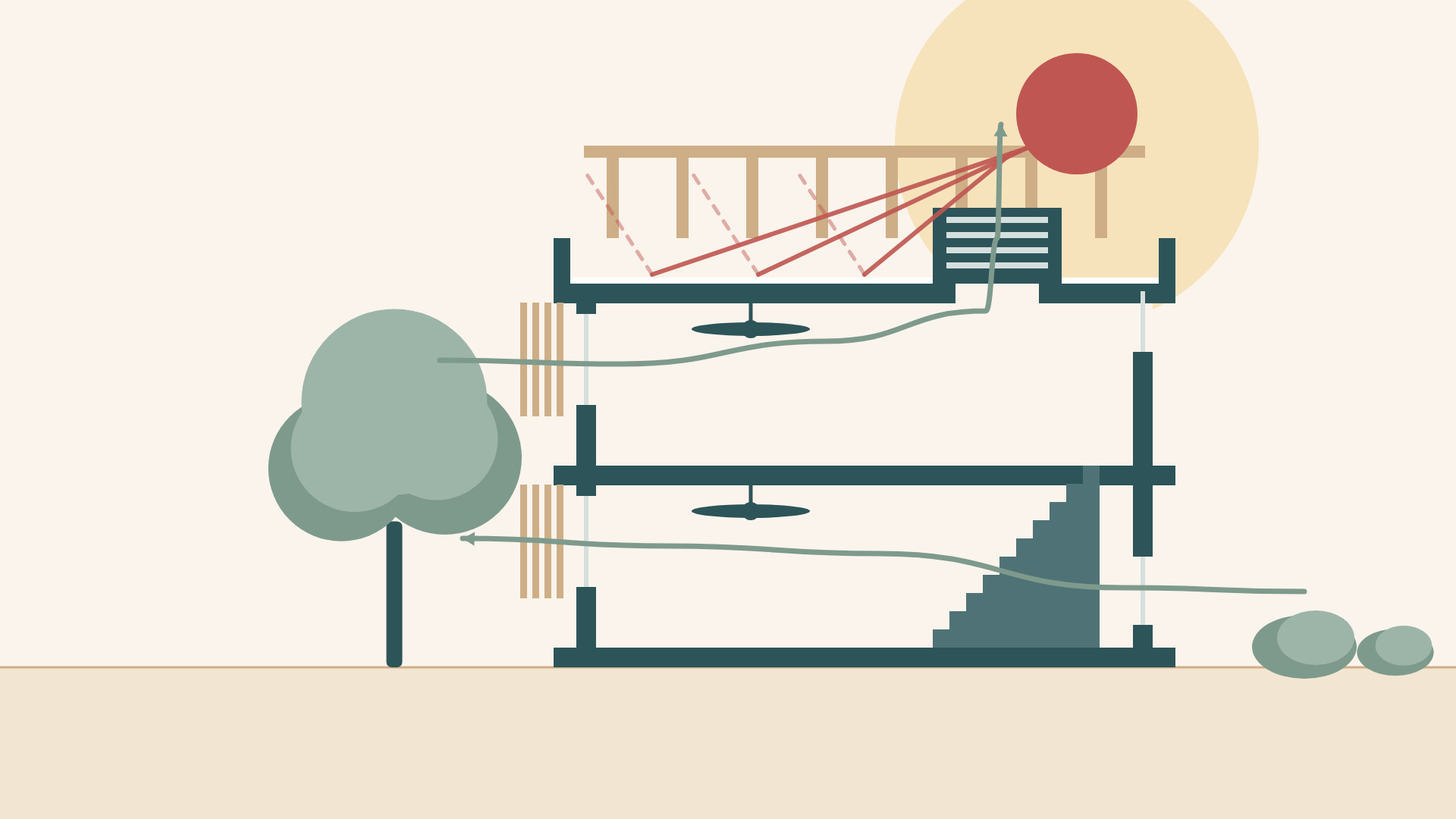
To keep a house cool without AC in a hot-humid climate like Bhubaneswar's, stop the sun before it reaches the roof and walls, shade each window according to the direction it faces, move air through every room, and avoid storing the day's heat into the night. Start with the roof: in summer the sun stands almost straight above it.
Bhubaneswar is classed as warm-humid in BEE's energy code for homes. The mean monthly temperature peaks at about 32°C in May, and about 1,690 mm of rain falls in a normal year, most of it from June to September. In humid air, sweat evaporates slowly, so moving air does more for comfort here than in a dry climate. Decisions made at drawing stage decide whether a house needs AC in every room all summer, or only on the worst days.
Start with the roof
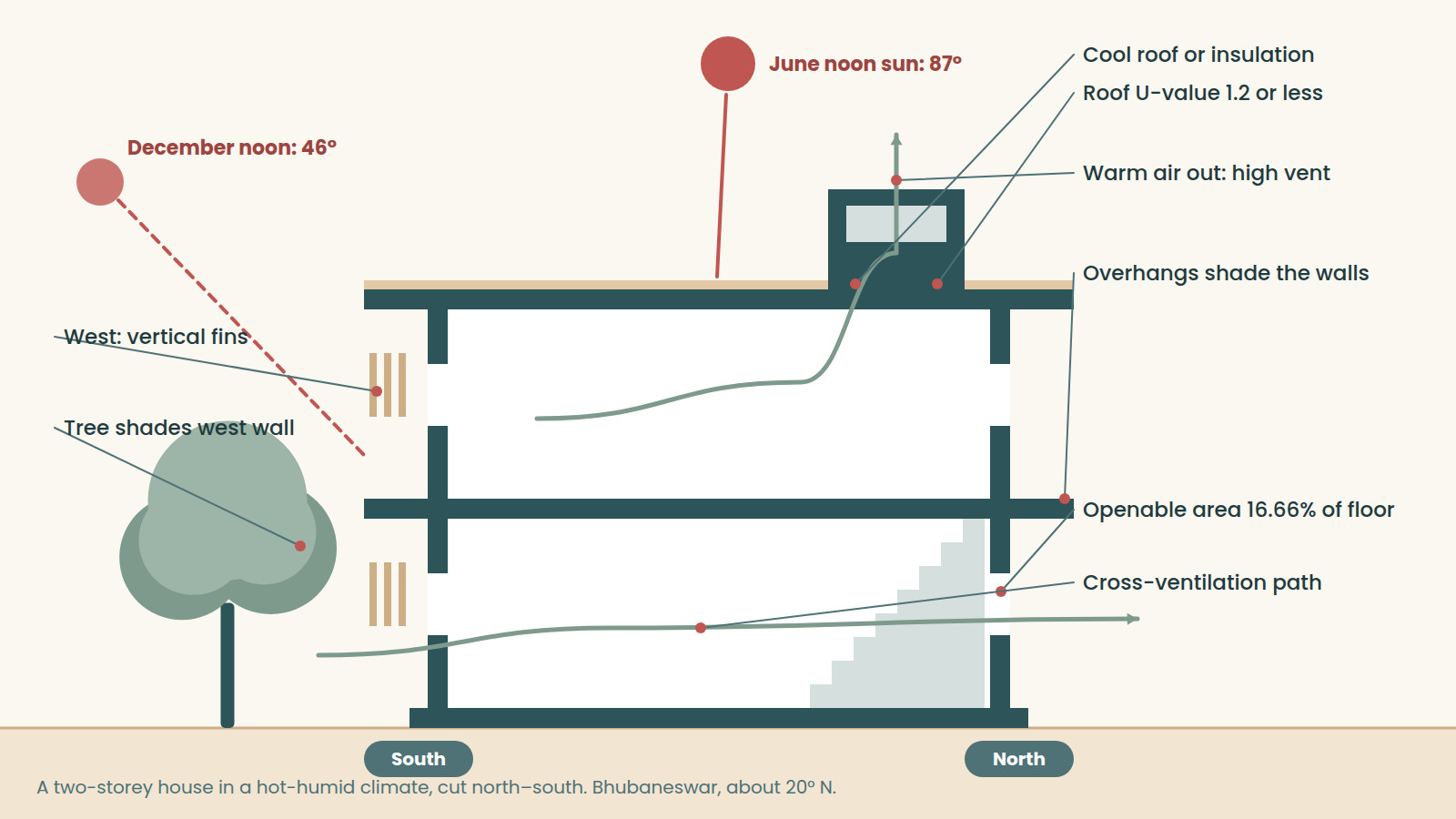
At Bhubaneswar's latitude, the June noon sun is about 87 degrees above the horizon, slightly north of overhead. A flat roof faces it almost square-on for hours, while the walls receive it at a glancing angle. On a single-storey house, and on the top floor of any house, the roof is usually the largest single source of heat.
BEE's Eco Niwas Samhita, the energy conservation code for residential buildings, caps the roof's thermal transmittance, or U-value, at 1.2 W/m²K. A plain concrete slab with nothing above it conducts heat readily and needs help to get there. The options, roughly in order of cost:
- Cool roof. A high-reflectance white coating or white tiles reflect much of the sunlight before it becomes heat. Indian cool-roof projects report indoor temperatures 2 to 5°C lower than under conventional roofs, depending on the building.
- Insulation over the slab. A layer of insulation laid above the slab, protected by tiles or screed, stops heat soaking into the concrete in the first place. Insulation works best on the outside, where it keeps the slab itself cool.
- A second, shading roof. A pergola, light sheet roof or raised solar panels shade the slab, with air moving freely in the gap between.
- A roof garden. Effective, but heavy and demanding on waterproofing, so it must be designed into the structure from the start.
Telangana's Cool Roof Policy, in force since April 2023, made cool roofs mandatory for residential buildings on plots of 600 sq m and more, and set a target of 300 sq km of cool roofs by 2028. The research it drew on found indoor air 2.1 to 4.3°C cooler under cool roofs.
Shade every window by its direction
Each side of the house needs a different kind of shade, because the sun reaches it at a different height.
- South. In December the noon sun is about 46 degrees up, in the south, and higher in every other month. A modest horizontal overhang keeps it off a south window for most of the year.
- East and west. The morning and afternoon sun is low, so overhangs alone fail. Use vertical fins, deep verandahs, jaalis, external shutters or trees, and keep west windows smaller.
- North. Mostly soft, indirect light, which makes it the best side for large windows. Between the March and September equinoxes, though, the sun rises and sets north of east and west, so short side fins help.
A little geometry shows why the south is easy. For a 1.2 m tall south window with an overhang at its head, full shade at noon in March and September, when the sun is about 70 degrees up, needs a projection of only about 0.45 m. Full shade at the December noon angle of about 46 degrees would need nearly 1.15 m. Many architects choose a depth in between and let some winter sun in, since December and January, with mean temperatures of about 22°C, are Bhubaneswar's mildest months and that sun is welcome.
The code limits heat gain through walls and windows with a figure called RETV, the residential envelope transmittance value. For the warm-humid zone the cap is 15 W/m² of envelope, excluding the roof. Shading counts directly in that calculation: a window under a deep overhang is credited with a lower solar gain than the same window bare.
Did you know? At latitudes below 23.5 degrees north, which includes all of Odisha, the code weights a west-facing wall or window at 1.156 for solar heat and a north-facing one at 0.659. Per square metre, a west window is treated as admitting about 1.75 times the solar heat of a north window. South, at 0.966, scores lower than east, west, south-east or south-west, because the sun is high when it is in the south.
Move the air through every room
In a humid climate, air movement is the main comfort tool. The residential code asks for openable window area of at least 16.66 per cent of floor area in the warm-humid zone. For a bedroom of 12 sq m, that is about 2 sq m of opening, not just of glass. A two-track sliding window opens only half its width, so a 2 sq m slider gives about 1 sq m of air. Casement windows open fully.
- Put openings on opposite or adjacent walls, so air has a path through the room, not just into it.
- Face the larger openings towards the breeze where the plot allows, and do not block the outlet side with a wardrobe.
- Use ventilators above doors or jaali panels in internal walls, so air can cross the house when bedroom doors are shut.
- Plan for ceiling fans in every room, centred over where people sit and sleep.
Let hot air rise and leave
Warm air rises. Give it a way out near the ceiling and cooler air is drawn in lower down: the stack effect. High ventilators, clerestory windows, an open staircase with a vent at the top, or a courtyard all work this way. The effect is strongest when the house is warmer than the air outside, typically in the evening. On still, muggy nights it weakens, and fans have to do the work.
Mass or insulation: what works in a humid climate
Heavy masonry absorbs heat by day and gives it back by night. In a hot-dry climate with cool nights, that evens out the day. In a warm-humid climate, nights stay warm and humid, so heat stored in a thick roof or west wall returns to the rooms after dark, just when you want to sleep. The better strategy here is to insulate the roof, shade the walls, keep the west wall buffered by a verandah or service rooms, and let the house breathe at night. Internal walls can stay solid; they are not facing the sun.
The ground around the house
Trees on the west and south-west shade walls and windows during the hottest hours. Grass and planting stay cooler than paving, which stores heat and reflects glare into windows. Light-coloured outer walls absorb less sun than dark ones. Large areas of glass, especially facing west, are the quickest way to undo every other decision. For coastal plots, salt air also shapes the choice of fins, grilles and fixings, as we cover in building near the coast in Odisha.
Questions people ask
Does white paint on the roof really make a difference?
Yes, if it is a proper solar-reflective coating rather than ordinary paint, and if it is kept clean. Studies in Indian cities report rooms 2 to 5°C cooler under cool roofs, depending on the building and the roof below the coating.
Can I cool an existing house without rebuilding?
Often, yes. A reflective roof coating, external shading on west windows, ventilators above doors and a few well-placed trees are all possible on a finished house.
Is a courtyard a good idea in Bhubaneswar?
Yes, if it is shaded, sized for the rain and drained properly. A courtyard brings light and air into the middle of the plan, as we discuss in vastu for home.
Will I still need AC?
Perhaps in bedrooms on the most humid nights. Good passive design cuts the hours and the size of AC you need, which is where the running-cost savings come from.
Where an architect makes the difference
Comfort without AC is decided by orientation, roof build-up, window sizes and where each opening sits, and all of these are fixed in the drawings. For your plot, a good architect would map the sun on every face, size and shade each window, plan a cross-ventilation path for every room, and specify a roof that meets the code limit. It adds little to the construction cost when planned early, and pays back every month, as our guide to a house that costs less to run explains. If you want the detail, the Eco Niwas Samhita residential code is public. Our architecture practice designs for climate first.
If you would like a cooler house on your own plot, talk to our architects.